
What’s Secretly Demotivating Your Agents?
Discover the hidden leadership mistake quietly causing stalled performance, low accountability, and inconsistent production on your real estate team… in less than 2 minutes.
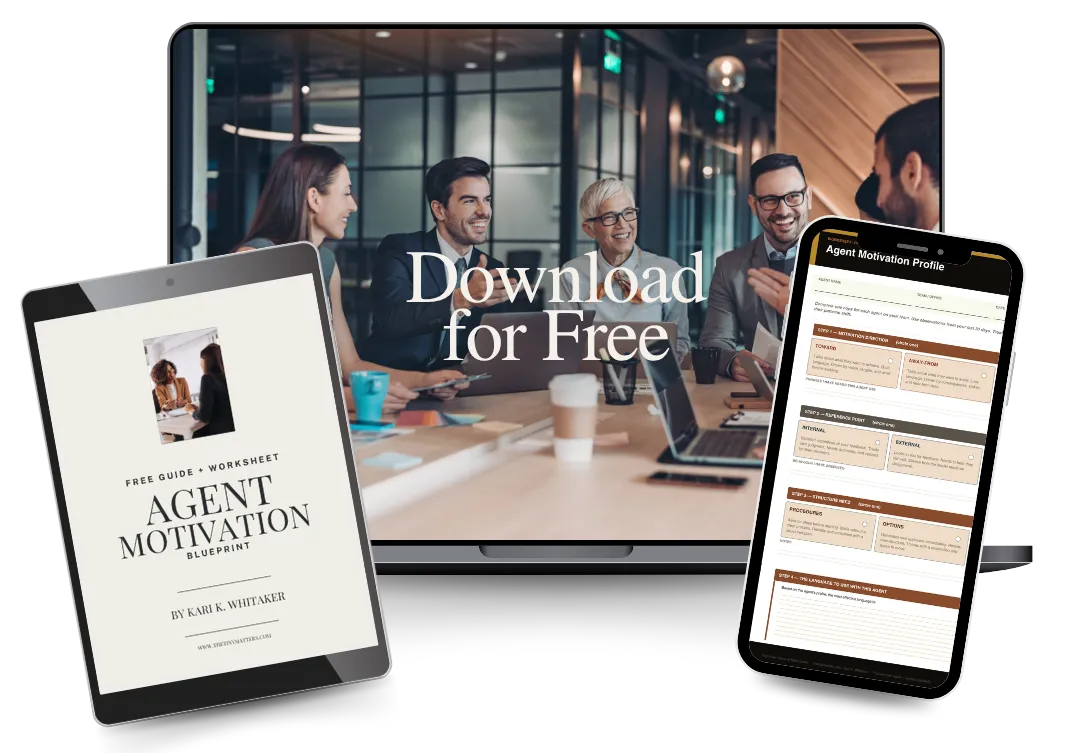
Why Better Systems Still Fail Without the Right Leadership Identity

You can have the scripts, the systems, and the strategy and still watch your team perform at 70% of what it's capable of. Here's why. And what actually changes it.
Introduction
There is a moment almost every team leader I've worked with can point to exactly.
The moment they stepped out of being the top producer... the one who performs and becomes the person responsible for everyone else's performance.
On paper, it looks like growth. A bigger title. A bigger team. A bigger problem to solve.
In reality? It can feel disorienting in a way nobody warns you about. Because the skills that made you exceptional as an agent — drive, independence, precision, the ability to outwork the room are not the same skills that make you exceptional as a leader.
So most team leaders do what high-achievers do when they hit a new challenge. They learn the tactics.
Better systems. Stronger accountability frameworks. Clearer scripts. More structured meetings. More coaching conversations. More check-ins.
And the team still doesn't perform consistently.
Not because the team lacks potential.
Not because the leader lacks effort.
Not because the strategy is wrong.
Because leadership is not primarily tactical.
It is identity.
And that realization changes everything.
Your Team Is a Mirror
One of the hardest truths in real estate leadership and one I come back to in almost every coaching conversation I have is this:
Your team rarely performs at the ceiling of their capabilities. They perform at the ceiling of your internal state.
If you lead with uncertainty, your team feels uncertainty even if you never say the uncertain thing out loud. If you avoid the difficult conversation, your team learns that avoidance is acceptable. If you silently criticize yourself after every decision, your team absorbs that standard and applies it to themselves.
Culture is not created by the words on a mission statement or the agenda of a Monday meeting.
Culture is created by repeated emotional patterns. And those patterns start with the person at the front of the room.
NLP and neuroscience both point to the same mechanism that psychology calls "emotional contagion." Human beings are wired to mirror the emotional energy of the people around them, particularly authority figures. It is not a conscious process. It happens before anyone processes a single word of what you've said.
Your confidence spreads through a room before you open your mouth.
So does your doubt.
So does your fear.
So does your certainty.
Teams are extraordinarily perceptive. They may not be able to name what feels off.
They may not point to a specific conversation or moment. But they feel the emotional environment the leader creates every single week, and they perform inside it.
This is why some teams underperform despite having access to excellent strategy, strong lead sources, and capable agents. The issue is rarely the strategy. It is the emotional environment the strategy exists inside.
The Hidden Cost of Unaddressed Self-Doubt
Most leaders believe their internal struggle is private.
It is not.
The way you speak to yourself directly influences the way you lead others. Not in theory, but in practice. In the specific words you choose in a 1-on-1. Whether you hold the silence after asking a hard question or rush to fill it. Whether you hold firm on your price recommendation or soften it before the seller has said a word.
Leaders who constantly question themselves create cultures filled with hesitation, not because they told anyone to hesitate, but because people model emotional behavior more reliably than they follow verbal instruction.
I see this pattern specifically with commission confidence.
A team leader who quietly doubts their own value will produce agents who discount their commission not because they lack the script, but because the leader's energy gave them permission to. The words said "hold the line." The state behind the words said something different. And the agent felt the difference.
Unresolved internal patterns eventually become organizational patterns.
The culture always reflects the leader's inner life whether the leader is conscious of it or not.
This is why leadership development cannot stop at tactics. You can learn every objection handler, every negotiation framework, and every accountability system and still produce a team that performs at 70% of its capability. Because the ceiling on the team is the unresolved ceiling inside the leader.
And most real estate professionals were never taught this. They were taught how to produce. Not how to regulate themselves emotionally while responsible for other people's performance.
Why Strategy Alone Doesn't Fix Team Performance
The real estate industry is not short on information.
More training. More scripts. More coaching programs. More productivity systems. More Monday morning motivation.
And yet burnout continues. Turnover continues. Inconsistency continues.
Because strategy without internal alignment creates friction.
People do not just respond to instructions. They respond to emotional safety. To certainty. To a leader who is genuinely settled in who they are and what they believe not performing those things, but actually living them.
Two team leaders can deliver the exact same price recommendation to a seller. The same words. The same data. The same script.
One gets agreement. One gets pushback.
The words were identical. The state behind the words was not.
In NLP, we call this the difference between congruent and incongruent communication. When what you say and what you feel are aligned, people trust you. When they're not people feel it. Even if they can't name it.
Leadership is emotional architecture.
Whether intentional or not, every real estate team leader is constantly shaping the emotional environment of their office. The question is not whether you are doing it.
The question is whether you are doing it consciously.
Identity-Based Leadership.What It Actually Means
I want to be direct about what I mean by identity because it is not a vague concept in the work I do.
In NLP, identity is distinct from behavior. Behavior is what you do. Identity is who you believe you are. And identity shapes behavior at a level that tactics never reach.
A team leader can change their language, their systems, and their accountability structures. But if the identity underneath those changes hasn't shifted... the old patterns return. Under stress. In high-stakes conversations. In the silence after a seller pushes back.
The strongest leaders I work with have all arrived at the same realization eventually:
Leadership is less about controlling others and more about mastering yourself.
That means developing:
The ability to regulate your emotional state before you walk into a room, not perform regulation, but actually access it
Internal certainty that doesn't depend on the client's response or the agent's reaction
Honest self-awareness about the patterns running underneath your leadership, the ones you have been managing around instead of through
The capacity to hold silence, hold pressure, and hold your agents accountable without it costing you the relationship
Self-trust that is grounded in who you are not in last month's production numbers
When leaders begin doing this internal work, the shift in team performance is often faster than anyone expects.
Not because the tactics dramatically changed. Because the emotional environment changed. And teams follow the emotional environment more reliably than they follow any instruction.
The version of your team you want to build is directly connected to the version of yourself you are willing to become.
That is not a motivational statement. It is a mechanism. And it is measurable.
The Future of Real Estate Leadership Is Psychological
The real estate industry is changing. Authority alone no longer retains great agents. Top performers...the ones every team leader is trying to recruit and keep want something more specific now.
They want a leader who creates clarity instead of confusion. Stability instead of emotional unpredictability. A culture where accountability is real, feedback is honest, and the energy in the room is something they want to be inside.
The leaders who will build the strongest teams over the next decade are not the ones with the best scripts or the highest production numbers.
They are the ones who have done the inner work that makes all of those things land.
Because emotionally regulated leaders create emotionally stable teams. And emotionally stable teams perform consistently, sustainably, and without requiring the leader to be the engine for every single person's motivation.
That's what the inner game of leadership actually is.
And it is available to every team leader reading this right now, exactly as they are.
Ready to Lead From the Inside Out?
You’ve built the business. You’ve mastered the tactics.
Now it’s time to become the leader your team actually responds to.
If you’re ready to increase confidence, strengthen your leadership, improve team performance, and stop carrying the emotional weight of your business alone, let’s talk.
Together, we’ll uncover:
- What's really creating the ceiling in your leadership or production
-The hidden mindset patterns affecting your team and income
-How identity-based leadership creates sustainable growth without burnout
- What support, clarity, and emotional regulation could look like in your business
This is not another generic coaching conversation.
It’s a strategic, honest look at where you are, where you want to go, and what’s been standing in the way.


Videos
Join Our Newsletter





Written by:
Kari K. Whitaker
a best-selling author, business, life, and success coach, and public speaker who helps entrepreneurs especially Realtors and coaches unlock higher performance by mastering their most powerful asset: the mind, combining her role as a Certified Master Practitioner of Neuro-Linguistic Programming with advanced certifications in hypnotherapy, TIME Techniques, EFT, and success coaching (board certified through the International Board of Coaches and Practitioners) to teach clients how to become the true CEO of themselves, guided by her core belief that “all of life is for learning” and her unwavering commitment to integrity, which drives her to lead by example and empowers her clients to embrace discomfort, break limitations, and create meaningful, lasting transformation.


We help real estate professionals achieve 3x more success by mastering ethical NLP and conversational hypnosis to create clarity, confidence, and consistent deal flow without pressure or manipulation.
QUICK LINKS
ALL SERVICES
CONTACT US


